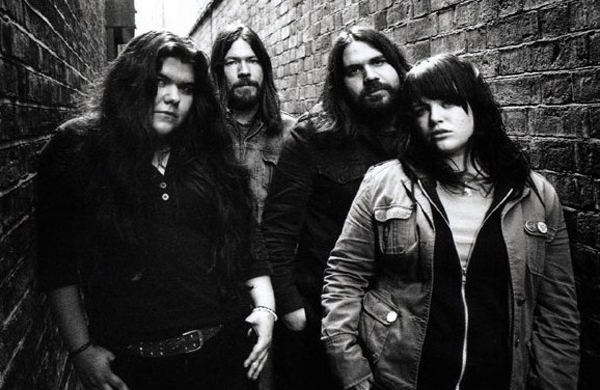
INTERVIEW: The Magic Numbers (UK), July 2010

Seriously, y’all, how fucking underrated are the Magic Numbers? Their self-titled was one of the best debuts of the decade; and they’ve made interesting and wonderful records in the years following; up to and including this year. I dunno what more I have to say. I guess I could also add in that Michele was an absolute sweetheart. I got to meet her and Romeo after the Magic Numbers show at the Metro not long after this interview and she was super-wonderful there as well. This feature’s okay. I think you can tell I’m a fan, which is surely a good thing, right?

– DJY, October 2014

***

It’s been awhile since we’ve heard from The Magic Numbers. Too long, fans will surely add. Thankfully, bassist/vocalist Michele Stodart is quick to clarify on the line from the U.K. that the group were never going to split.

“We all just went away after the tour of the second album [2006’s Those the Brokes],” she observes, “and, y’know, get a break from the band, and each other. There was also our dream of building our own studio, which we’ve always wanted to do. We bought lots of equipment and built it up over about a year and a half – it was amazing because we finally had our own area, our own rehearsal space.” It was here where the band recorded their third album, The Runaway, up until late 2009. Set for release in a matter of weeks, fans are to expect the unexpected when it comes to the band’s new explorative sound.

“When we were rehearsing these songs,” explains Stodart, “we felt like they were too easy; that we could have just gone straight in and recorded them. Let’s try and actually make an album, instead of worrying how we’re going to do it live. So we kind of played around with the set-up of the four of us – thinking ‘okay, this doesn’t need bass; you don’t have to play the drums; [brother and lead vocalist] Romeo doesn’t have to play guitar.’ We mixed it up. It’s still the band, but on the record it’s more than that.”

Another one of the variations included on the record was Michele and vocalist/keyboardist/percussionist Angela Gannon (who completes the lineup with drumming brother Sean) contributing lead vocals to individual tracks. Michele has contributed lead vocals previously, but this the first time a song with her on lead has been chosen as a single. “It’s quite funny,” she comments with a giggle, “and it’s kind of a big deal, too. I’m not too sure how it’s going to go down, but it’s gotten a pretty good reception on the live front, so that’s been a lot of fun.”

On that note, conversation switches to the band’s live shows. This is a band that have established a rock-solid reputation as a must-see live act – they once sold out a 2500-capacity venue in the U.K. even before their 2005 self-titled debut had been released. Recently, the group have gone back on the road to try out the new material as well as pull out some old favourites for patient fans who haven’t seen the group since 2007 at the latest. One of their biggest profile appearances recently has been the annual Glastonbury festival – and Michele couldn’t have been quicker to sing its praises.

“It was amazing,” she recalls fondly. “It was probably one of my favourite Glastonburys because it’s the only one that I’ve been to that wasn’t muddy! No need for wellies whatsoever [laughs]. We kickstarted the festival on the Other Stage and we were so surprised. We didn’t think there’d be many people out to support us, seeing as we’ve been away so long – I was backstage fretting that there’d only be ten people out there and they’d all be passed out. We head out, and it’s packed! That was a really pleasant surprise – an amazing experience.”

Although on somewhat of a smaller scale in comparison to Glasto, a great festival experience is surely on the cards for the band when they take to the stage at the upcoming Splendour in the Grass festival in Woodford. Michele is jolted with excitement when she realises it’s in a matter of weeks – “We’re really looking forward to it!” she enthuses. “We’re only there for a week, but it’s going to be amazing. I hope the weather’s good, obviously; and we’re hoping to explore more of the country while we’re there.” Stodart recalls the band’s enjoyment of their 2005 tour as a part of the Big Day Out, claiming it was a “great chance for us to just spend a lot of time hanging out with the other bands and really take in an overseas country properly for the first time.” There’s little doubt that there will be plenty of great experiences for the band in their whirlwind Australian visit.

As for her own personal projects, Stodart also reports on working on her debut solo album (although it “might be awhile” before we hear anything from it), and also giving birth to her first child – a girl, Maisie. “She’s perfect, really,” says Michele. “She’s really, really cute. A lot of hard work, but she’s still perfect.” Motherhood has certainly had an overwhelmingly positive effect on Michele, but she believes it would be against her nature to dedicate her life to raising Maisie alone.

“It’d kind of be easier to do that,” she says when asked if she would ever pack the whole music thing in, “but I just know that I wouldn’t be happy. Now I’m trying to fit everything in – which is hard work, but I know that what I’m doing is the best for me and for her right now. Music is too big a part of my life for it to be extracted, and I know that she wouldn’t get the best mum possible. Even now, I’m here in the studio working on one of the b-sides for the single while she’s asleep. It’s a different kind of perspective that I’ve got, but I don’t think I could ever give up music.”

INTERVIEW: Ladyhawke (NZ/UK), June 2012

I think I became a bigger Ladyhawke fan after I found out we were on the same team. This is the only time I have ever had the pleasure of interviewing another Aspie, and it felt pretty fantastic to be able to discuss the creative process with her knowing that she’d probably had a lot of the same issues as me. It really lifted the mood and brought a lot of honesty to the interview, as well. She still had a lot of issues with her live show when I saw her the following month, but I understood them a lot more this time around. Anyway, Pip’s great. No idea what she’s up to these days. I hope she’s still being creative and embracing her Asperger’s.

– DJY, October 2014

***

It’s hard to pin down Pip Brown – not just because she is constantly on the road, but also in a musical and mental sense as well. The Wellington-via-Sydney-via-London musician best known as Ladyhawke has gone nearly four years between albums, touring incessantly and plotting a follow-up to her eponymous debut. The results have been, at times, drastically different to what has become expected of Brown – and the album Anxiety benefits significantly because of it.

“It’s almost like an inevitable curse that’s placed on every musician,” says Brown, in a London hotel following the conclusion of her U.K. tour. “When success comes with the first record, people will always tell them that they’re going to have trouble with the second one. Even if the album is awesome, some people will find it shit just because it’s a second album. The whole time I was making Anxiety, I was worried about that.” She recalls a particular encounter with a fan that enforced her fears more than she had expected it to. “I had someone come up to me in a shopping mall in New Zealand,” she says, “and they were just gushing – ‘Oh, Ladyhawke! When’s your new album coming out? Is it going to be electro?’ I was wondering why they’d think that; because it isn’t, y’know. That made me think that maybe people wanted me to make an electro record – but I didn’t want to do that. It’s hard to put all that mental stuff aside and just get my own creativity going.”

While Anxiety maintains a “more hooks than a bait shop” approach, its demeanour is suitably darker and occasionally more aggressive than its predecessor. Its inspiration lies in Brown’s desire to wipe the slate clean. There was no point in making Ladyhawke again – that album already exists. “It was just a time in my life when I had toured the first record for two years,” says Pip, “and when I finished, I realised that there was no part of me that wanted to make that album again. I knew that I didn’t want to make ‘Ladyhawke Mark II’ or whatever. I wanted to do something new that would inspire me and interest me in making songs again. I had this idea of trying out some really rocky, grungy sort of tracks. They were still poppy, but the tracks ended up making for a rockier album. Anxiety really just reflects my mindset at the time. I wanted to experiment with sounds that I hadn’t tried on the first album. You’ve got to keep it interesting for yourself.”

Discussion of songwriting continues, with Pip revealing a somewhat stubborn eccentricity in her constant rejection of song ideas – no matter how much potential they show, if she doesn’t have that certain feeling about them from the very start of the songwriting process they will be cut. “You tend to know when you start the song,” she affirms. “It’s all about the gut feeling. If I don’t have that feeling about the song, I have to trash it. It has to be gone. That’s one of the ways that I work.” Of course, this is a mindset that discomforts some of the people she has worked with, particularly her co-producer on Anxiety, Pascal Gabriel. “Some producers I’ve worked with are more practical and want to push through on those kind of songs,” she says, “but I feel like if I don’t have that feeling from the start then there is no point pursuing it. Even if I did push through and take the song to a finishing point, I would still feel like it was mediocre. I’d rather trash it and work on something that gives me a buzz. If I’m getting butterflies in my stomach from a bassline, then I’ll stop working on something mediocre on guitar and go towards that.”

“It’s so important that you’re excited about what you’re doing,” she continues emphatically. “You can’t be complacent. You really have to be excited about your own music. Otherwise, what’s the point?” A few listens through Anxiety will suggest that there is plenty to be excited about – from the sour honky-tonk piano of Sunday Drive to the booming bassline of Girl Like Me, it’s a confident and engaging record that explores the wider spectrum of pop music, as heavy on synthesizer as it is on guitar. Perhaps most notable of all is that every last note that you hear is entirely Brown’s vision. “All the instruments recorded on this album was me” she says. “My live band are still just that, they’re all session musicians who come on the road with me. I prefer it that way – that’s part of my process. It’s about picking up an instrument and playing, working a song out. It doesn’t make any sense in my brain to hand that over to someone else when I could do it myself.”

This peculiar drive and heavy investment into the sound of the record, sacrificing interaction with other musicians in order to get the album exactly right, might seem out of the ordinary for a lot of musicians. What’s worth considering, however, is that Brown’s very specific interests and aforementioned need to get rid of unsatisfying songs can be traced back to her Asperger’s. A form of Autism, Brown first spoke publicly about it in an interview with The Guardian in 2008. Although not something widely discussed in relation to Ladyhawke it’s something that Brown speaks passionately about in regards to how it affects her life – as well as how it can completely disorientate a live performance.

“It’s completely unpredictable,” says Brown, explaining what being an Aspergian can mean for a touring musician. “I can be really calm on stage sometimes, but there are others where I feel like I want to vomit. Those times I’ll look down at the setlist and realise that I’m only three songs into the set. It feels like ten years. There’ll be other times when you think you’re on a roll, having a great time, too. So I really can’t predict what’s going to happen, and it’s really annoying. It hasn’t changed, either. People often assume that with all the touring I do, it would just get better over time. It’s still exactly the same.”

It’s these assumptions that continue to frustrate Brown, 33 next month, who was only diagnosed with the syndrome in 2006. “Other people say to me that it just comes with what you do,” she says as our discussion on Asperger’s continues. “’Just deal with it,’ that kind of thing. I think that’s really not fair. As a young person loving music, you simply just sit in your room and you play. All you want to do is play music and play with your friends. You actually don’t even realise what that’s going to be like. You don’t sign up to become a musician for a lot of the things that go with it. You do it because you love music; because you love playing music. All of a sudden, you have to think about doing interviews, which can be quite hard; you have to meet loads of people that you really have no idea what to say to. We’re not actors, we’re musicians. People often lump the two into the same basket. Some of us are still really scared of the limelight, and just want to play music.”

She speaks intently and with an overwhelming vindication on the subject. Outside of discussing the creation of her music, it’s a topic that brings out the most fascinating responses in Pip. “It’s kind of hard to justify myself sometimes, just because I feel like I have to with some people,” she concludes. “I love playing music. I just can’t see myself doing anything else.”

INTERVIEW: The Specials (UK), April 2012

To this day, I count this feature as one of the best I’ve ever written. It was easily the best feature I’d done up to this point, and one of my favourite interviews I’ve had the pleasure of doing over the six or so years I’ve been doing them. I had no idea what Horace would be like to interview – I figured Terry would be very blunt, and that Neville would be incredibly bubbly and talkative. But what of the man holding it down up the back? Well, as it turned out, he was an incredibly insightful, polite and very charming interviewee. Incredibly grateful for having been able to chat with this legend. See for yourself.

– DJY, October 2014

***

They were a pioneering force of ska music that not only brought the genre to attention in the U.K, but inspired countless other bands to do the same. They’ve fought political and social injustices as hard as they’ve fought with one another. There’s been fall-ins, fall-outs, alleged backstabbing and lyrical controversy in career that spans decades and a history as fruitful (and tumultuous) as any. And here you were thinking they were just that band with that Ghost Town song.

The Specials have cemented a legacy as one of the most important U.K. bands of the 70s, depicting the troubles of their beloved country in a way that had never quite been attempted before. Issues such as racial division and teen pregnancy were brought to life in a mix of proto-reggae and rhythm-and-blues, with upbeat drums, big horns and even bigger chorus sing-alongs. Commonly referred to as the 2-Tone sound – after the label started by former keyboardist Jerry Dammers – The Specials achieved a remarkable amount in their considerably short initial run, lasting less than a decade before splitting in 1984.

To mark thirty years since their inception, the band reunited in 2008, featuring every member from the line-up that recorded 1979’s iconic Specials record (excluding Dammers). Fast forward to 2012, and the current line-up of the band – which also features keyboardist Nik Torp and a new horn section – are still actively touring across the world, returning this month to Australian shores for only the second time in the band’s career. It must be asked, given the brief time originally spent together as a band, did the Specials ever expect their 21st century form to last as long as it has?

“No, no I didn’t,” says bassist Horace Panter with a laugh. “I didn’t anticipate the reaction. I knew we’d be well-received, but I didn’t think there’d be as many people out there to receive us well, if you know what I mean. The numbers in the audiences have exceeded my expectations.” He goes on to describe the culture shock of seeing a new generation of Specials fans coming out to the shows. “We spent 2010 doing festivals in Europe, and we would play in front of up to ten thousand children that obviously hadn’t been born when these songs were recorded. But they were singing all the words! We were playing places like Belgium where this was happening – it was just crazy.”

Of course, there are several ways that younger fans may have found their way to The Specials, particularly through cultural references and their influence on many other bands and genres. One name that comes up, however, is the late Amy Winehouse: the troubled singer was a huge fan of the band, covering their Hey Little Rich Girl as a B-side on her Back to Black single and performing a version of Monkey Man that drew far much more from The Specials’ version than the original by Toots and the Mayals. As talk turns to Amy, Panter shares a very peculiar story about performing with the late star.

“We were playing on the V Festivals, it must have been 2009,” he recalls. “Terry [Hall] went off stage for one song that Roddy [Radiation] sang. She was standing side of stage and she started asking Terry if she could come on and do a song. Terry ends up saying ‘Alright, then.’ We decided to do You’re Wondering Now, and then Terry announced to everyone that ‘We’re going to be joined by our friend Amy here.’ We all looked around the stage at one another and just went ‘What?’

“This stick-thin creature with huge hair comes out of nowhere,” he continues, “and just starts singing. It was extraordinary. She did quite a good job, too. She was either going to be really, really dreadful; or she was going to be great – and she was pretty amazing, actually.”

Of course, Winehouse’s career was one that was cut tragically short due to issues with drugs and alcohol. Although Panter more often than not found himself surrounded by drug culture in most guises, he emphasises that it was never something that he truly immersed himself within. “I was always the boring one. If you read Pauline Black’s autobiography, I’m actually castigated by her because I didn’t take drugs. I was once offered a joint by Keith Richards, and I turned it down. He looked at me and said ‘Man, you have got a problem!’” He laughs, followed by an adding, in a lower tone: “Pretty rich coming from him, if you ask me.”

“The problem in the band originally was that there was different cultures – alcohol culture, marijuana culture, powder culture,” says Panter, analysing some of the smaller things that assisted in the band’s untimely demise during their initial run. If we were all drunks, or all cokeheads or all dope fiends…it probably would have been better, because at least it would have meant that we were all on the same level. The dope smokers were really mellow, whereas the ones out of their mind on coke were always asking if we could play the song faster. The drunk ones were just having trouble tying their shoelaces.”

Surviving drug culture is one thing, but surviving issues within Specials songs such as racism, social justice, gang violence, unemployment and the ever-looming corporate rat race is a different matter entirely. It seems both positive and disappointing that songs written so many years ago still have sentiment and meaning that rings true within today’s society – the former because it presents these songs as timeless, but also the latter because it suggests that very little has changed in that time. It’s something that weighs upon Panter’s mind, too:

“Injustice is timeless, isn’t it?” he questions, wearily. “Exploitation is always going to be prevalent, I think. It’s human nature. Although racism still manages to rear its ugly head every now and then, I feel it’s a problem that is far better handled by subsequent generations than it was 30 years ago. I think that’s because children have grown up with kids from other races – they’ve gone to school with them, played football with them.”

“But am I disappointed that these issues still exist?” He poses the question back at himself, starting a couple of sentences before leaving them hanging in the air. “I was never expecting a Utopia, to be honest,” he concedes finally. “I don’t think that exists. If we’ve helped people make their minds up, then at least that’s good. It’s a difficult thing – I don’t want to come across as pretentious, and I don’t know how you’re supposed to do market research on that, y’know? Tick the box: ‘Yes, I have listened to The Specials lyrics, they’ve changed my life!’ All I can really hope is that we’ve been a part of some sort of process that’s had a positive outcome.”

Whatever you make of what legacy the Specials will leave behind when it ends (again), there’s no denying its impact. Panter himself has been there for the majority of it, having been a part of The Automatics alongside school friend Dammers in ’77, leaving the fold in 1981 with the majority of the original line-up, playing in the group Special Beat in the first half of the 90s and returning to the Specials name in the second half, sans Hall, Dammers and drummer John Bradbury. Having been a part of nearly every version of the band for over 30 years, what has brought Panter back to the fold so many times over in spite of a turbulent history? The answer is quite simple: Panter feels as though he was born to do it.

“I suppose it’s what defines me,” he says. “It’s what I do. It’ll be on my gravestone: ‘He was the bassist in The Specials.’ It won’t be ‘He was a pretty good art teacher’ or ‘He drove a pretty good van.’ It’s my destiny.”

INTERVIEW: Rolo Tomassi (UK), December 2010

I discovered this band by pure chance at a Soundwave some years ago and I’ve dug them ever since. A consistently weird and generally wonderful band that exist on the outside of every genre they blend into their music – and that’s just fine by them. I’ve met the Spence siblings from the band several times, including at their Australian tour last year. They’re incredibly polite and charming folk. That’s all I have to say on the matter, really. 

– DJY, October 2014

***

There was plenty to see and do at this year’s Soundwave festival, but for those who managed to sneak in early, one new band was the talk of the early hours of the festivities. That band was arty British post-hardcore kids Rolo Tomassi, with a deceptively attractive frontwoman in Eva Spence who went on to screech and howl like some kind of rabid dog; as well as having at least half of the members leaping off the stage to crowdsurf at one point or another. Love them or hate them, they certainly generated a reputation, turning many perfect strangers into huge fans.

“For us, it’s the most important thing in the world to do good live shows,” says Eva’s brother James Spence, the band’s keyboardist and co-lead vocalist. “We started the band to play shows more than anything, and we strive to be as good as we can be – tight, as energetic and as aggressive and imposing as we can be without wanting to alienate anyone. We just want to be fun to watch and fun to be a part of.”

Working up from D.I.Y. shows and home-made cassette demos, the band evolved from a project between the Spence siblings to expand into the quintet that it is today. The band have two albums under their belt – the latest of which, Cosmology, was released in May of this year, produced by former M.I.A. and Santigold collaborator Diplo. In spite of Cosmology arguably being the band’s most technical and intrinsic work to date, the band were fully confident in their abilities to translate this to the live environment.

“It’s easier for it to be difficult to play than to worry it won’t sound good live,” Spence says. “Essentially, if something’s difficult, we can always practice it for ourselves. I think that’s the main difference between the first and the second record – there were some songs on the first record that we had to modify to play live, and none of us were really happy with that. We wanted to take what we’d done on the record and play that live and make a bigger energy, rather than change the songs. I think the difficult songs on the new album, we’ve mastered and can be realised in their full potential when we play them now.”

Ahead of its release, fans in Australia were amongst the first to hear cuts from Cosmology road tested properly. Despite only being here for just over a week, Spence still has incredibly fond memories of what was the band’s first ever Australian tour – even going so far as to describe it as a “headfuck.” His voice picks up and the tone of excitement is too outstanding to ignore.

“Flying that far from home across the world to play gigs with our band is just a very, very strange feeling,” he says. “I don’t think any of us ever expected or assumed that we would ever get the opportunity to do something like that, so a lot of the time we were just walking around wide-eyed – we weren’t really sure how to behave or what to do. After getting over the jetlag, we really made the most of the trip, and really explored the place. We could have really been taken aback, but we decided to make the most of it while we were there.”

The tour also saw the band paired up in some Sidewave action with what FasterLouder deemed one of the strangest support acts of all time – Rolo were the opening act for Jane’s Addiction’s headlining shows. “You’re kidding!” says Spence with a laugh when informed of the band making the list. “That’s amazing. I’ll be honest – I couldn’t identify a Jane’s Addiction song if you played it to me. But the name is just one that sticks out – I mean, I knew what Dave Navarro looked like, and I knew who Perry Farrell was – but I wasn’t really familiar with their music; though I knew it was an odd pairing. I consider them the last of the real rock-stars, and we’re a very humble band with really strong D.I.Y. roots – so to see the complete opposite end of the spectrum was something else. They were great shows, though – the crowds were really responsive and cool.”

After working through a tonne of festival dates, as well as coming off tour with a much more fitting support slot – opening for the band’s heroes, The Dillinger Escape Plan – the time is nigh for Rolo Tomassi to make their return to Australian shores as a part of a quadruple bill with other acts from this year’s Soundwave – This Is Hell, Comeback Kid and headliners Architects. The enthusiasm kicks up a notch once more as Spence gears up for his band’s imminent return to our “fair country,” as he puts it.

“Us, Architects and Comeback Kid were all on the same stage,” he recalls. “The drummer from This Is Hell is from England, too, so we got to meet those guys. I’m a fan of that band, so I ended up watching them anyway. It’s gonna be great to catch up with everyone – we all hung out a fair bit on that tour, and we all played some of the same festival dates in Europe, as well. It’s gonna be really nice – there’s gonna be that sense of friendship amongst all the bands, so it won’t be awkward the first few days.”

INTERVIEW: La Roux (UK), February 2010

Hey, kids! Remember La Roux? …anyone? …really? None of you? Bulletproof? That shit was EVERYWHERE. End of the 2000s was a great time for synth-pop. Apparently there’s going to be a second album? Yeah, right. I bet it comes out the same day as the new Avalanches album. This was towards the end of the extensive touring for that incredible debut, and something called the Bacardi Express was happening; headlined by La Roux. I think Art vs. Science were on it, too? Bluejuice? Yves Klein Blue? Cassette Kids? I think that was it. Ahh, just checked. No Bluejuice. Miami Horror were there, too. HA! Remember those guys? 

I was really happy with this feature at the time. It was one of the more high-profile chats I’d done at the time; and Elly was quite nice – if a little secretive. I wonder if Tom Ballard was on the money with his assessment of Cover My Eyes

– DJY, April 2014

***

Poor Elly Jackson. It seems Australia can’t seem to get her at any good time. Our original scheduled interview time is delayed, and on the phone from London when we finally do come into contact, she notes that she’s a bit tired. “I’ve just woken up, in fact,” she informs.

Even before this, her first visit to Australia with the act she is the voice of, La Roux, was plagued with exhaustion and illness, resulting in late timetable swaps for their appearance at the Parklife festival and cancelled shows.

“That was sort of the beginning of my illness, unfortunately,” she says with a certain sense of worry in her voice. “I think it was just one too many flights and not enough early nights. I let it all get on top of me and then I got ill – and then, of course, there was no time to prepare myself, as we were to begin another tour straight after that one. So it was all just a build-up of things, unfortunately.”

In spite of this distressing Jackson, La Roux still put on some exceptional shows when they finally made it to the main stage. Her vocals a pitch-perfect sight to behold, the crowd adored every second of her Sydney appearance at the festival. Jackson is also very quick to note how much she enjoyed her first visit to the country, ignoring her illness.

“I loved it,” she enthuses when asked about the tour. “I had an amazing time – we were told that La Roux was doing well out there, but I didn’t have any idea to what extent. So playing to forty thousand people each night was always a surprise!”

Indeed, Australia has been good to Jackson and La Roux – even a recent example comes from two of their debut self-titled record’s major singles ( In For The Kill and Bulletproof ) taking out enviable top spots in Triple J’s annual Hottest 100.

On the topic of the station, it’s also interesting to note the interpretation of Cover My Eyes from the record in the eyes of openly gay Triple J presenter Tom Ballard. “As far as I’m concerned, this is an anthem for every gay man who’s fallen in love with a straight friend,” he wrote on the Hottest 100 page.

How does Elly herself feel about having her music interpreted like this – presumably quite different to how she originally intended it to be? She thinks for a moment, before noting: “I always like that.”

Jackson continues: “There was another instance where I was reading what people were saying on the MySpace, and there was this one boy who said that In for the Kill was the track that made him come out to his parents. He made it about doing something really courageous, in coming out. It is a song about courage, but you can take from it what you will. I mean, I know exactly what it means to me, but I think it’s really important that people get their own perspective on things like that. That’s why we make music – just when you hear something in your own take on it and you think, ‘I really like that.’”

It’s been nearly a year since the self-titled album dropped, which has seen critics divided but sales suggesting that of a pop juggernaut. Even after considerable success, however, Elly herself is still somewhat uncertain about the entire thing.

“I haven’t listened to it for months,” she confesses when asked about the record – a statement that is a little surprising, but ultimately makes sense. “I think now, that I’m playing these songs every night, I’ve grown used to them in their live environment.”

Jackson, too, remains a little iffy in regards to the finished product of the self-titled record. “We’ve gone over so many times if the bonus tracks should have been the album tracks, or if the album tracks should have been the bonus tracks, or what should have been left off entirely,” she muses. “I don’t think you can ever be truly satisfied with your own record – your first record, at least.”

By “we”, Elly refers to the man behind the instruments and production of the album – the other half of La Roux, Ben Langmaid. If you were unaware of Langmaid’s involvement in La Roux, perhaps thinking La Roux was Jackson’s moniker or alias, it’s understandable – aside from the music itself, he is practically a ghost. He refuses to be a part of photo shoots and videos, and declined to be a part of the live band when it came to putting the songs on the road.

Jackson knows, however, that the music of La Roux is far more important than its aesthetic – even with her wild hairstyle often the centre of attention.

“He’s just not interested in any of that stuff,” she says of Langmaid, with a certain degree of acceptance in her tone. “His focus is really just working on what he feels are good songs. He spends a lot of time in the studio, and I can’t really help that or hold it against him.”

In Langmaid’s absence on tour, Jackson enlisted the help of keyboardists Michael Norris and Mickey O’Brien, with electronic drummer William Bowermann (formerly of I Was A Cub Scout) completing the line-up. These aren’t session musicians, mind – they’ve quickly become some of Elly’s closest friends.

“Some of the funnest and most hilarious times of my life have been with my band,” she says with a giggle. “They are such amazing people – I missed them all so much when I was away from them on holiday. They’re like my family now. I don’t know what I’d do without them – even if La Roux all ended tomorrow, I know we’d still all see each other every second day.”

The four are making their way back to Australia in March, headlining the Bacardi Express tour alongside some of Australia’s strongest up-and-comers, including fellow Hottest 100 sensations Art VS. Science, Yves Klein Blue, Cassette Kids and Miami Horror. “We will be getting to tour with all the people that are involved, which very, very rarely happens any more, if at all,” Jackson comments enthusiastically. “It’s going to be a really nice way to see the coast of Australia!”

INTERVIEW: The Streets (UK), February 2009

On paper, The Streets was never something that should have properly taken off the way it did. And yet I’ve spent roughly a decade of my life listening to the poetry and beats of one Mike Skinner. I maintain that Original Pirate Material and A Grand Don’t Come for Free, his first two Streets records, are two of my favourite records ever. They just present such a unique and remarkable take on UK hip-hop, garage… music in general around that period. So naturally I was pretty stoked to be able to chat to Mike back in 2009 – even if a) It was on the back of his worst album, 2008’s Everything is Borrowed; and b) I had to get out of a Bleeding Through gig to speak to him. Actually, in retrospect, that second point wasn’t all that bad.

Mike was cool, regardless. You get out what you put in, and he could tell I was a big fan and had done my research. In turn, I got a fairly good chat out of him. I haven’t heard his new project, The D.O.T., but believe when I say it’s on my to-do list.

– DJY, 2013

***

“You sound alive,” Mike Skinner tells me. “Very perky.”

I graciously accept his observation-slash-compliment. Usually, you wouldn’t expect that degree of kindness from someone whose bleak, frustrated and brutally honest lyrics have become some what omnipresent on their last three releases. However, since the release of Skinner’s latest album under the moniker of The StreetsEverything is Borrowed, we may well have witnessed some kind of epiphany-based reinvention of both man and music.

Featuring an aura created by what Skinner has described as “peaceful, positive vibes,” the album boasts a title track with the mantra: “I entered this world with nothing, and I leave it with nothing but love/Everything else is just borrowed.” Chances are this new approach to the music of The Streets left you baffled, but as Skinner explains, it’s all a part of the plan.

“It was my intention to make a positive album,” he emphasises. “It’s the verses where things go wrong, but it’s the choruses that are really uplifting.” Mike goes on to explain that the concept behind Borrowed was to collate a collection of parables. “It was intended that the stories were not ‘me’ and not really what I was doing, y’know? Some people tend to think I’ve been walking along beaches and living the natural life… and I haven’t! I’ve been in a studio in London! But the concept was to tell these thoughts in a kind of indirect and imaginative way, which obviously I’d never done before.”

The album deals with more than just unhappy London life (2002’s Original Pirate Material ), a story of a man and his missing money (2004’s A Grand Don’t Come for Free ) or dealing with the foreign concept of fame (2006’s The Hardest Way to Make An Easy Living ). Everything is Borrowed is Mike Skinner looking at the bigger picture of life, and where he fits in.

Our conversation moves in on a particular intriguing lyric from the album: “Just when you discover the meaning of life, they change it.” This lyric appears to have been inspired by the way social acceptance and what is moral is constantly evolving.

“I think it’s important to remember that the moral zeitgeist changes,” he puts forward after taking a moment to properly phrase his thoughts. “Religious people like to think that they get their rules from the Bible; but if you look at the Bible, there’s all sorts of death, destruction and idiot torture going on. There’s also a scientific zeitgeist – the way we’re supposed to raise our kids, prolong our lives. I think it’s important to remember that everything could change – everything that you believe, that you think is okay, could end up being very different.”

If anyone knows how quickly everything can change, it’s Mike Skinner. Since the beginning of The Streets, British hip hop has slowly, but surely, become a globally recognised scene and culture. Even so, ask Skinner whether he keeps up with it, or even associates The Streets with it, and he is quick to downplay his part. “I don’t think any rapper wants to be me… in a way, I’m kind of irrelevant. But yeah, kind of subconsciously, I think my success has kind of changed things in rap – not me, personally, though.”

This month sees Mike bring out the live Streets band for a series of shows, as well as being a headliner of the Playground Weekender festival. He gives some quick opinions of the headliners: Primal Scream (“They’re cool, I used to have the same manager as them”), Cold War Kids (“I’ve only really heard one song of theirs, they’re alright”), Jose Gonzalez (“cool, lovely”) and Crystal Castles (“I don’t really know what to make of them!”). Skinner also tells of how surprised he is at the audiences he’s been seeing on tour this time around. “The fans seem to be younger than ever, the shows have been more successful than ever; doing massive shows in Europe… I have no idea where it’s come from, to be honest,” he confesses.

As so many international acts have done, Skinner goes on to praise Australia ahead of the tour. “Australia just really feels like you’re a long way from home, even though, culturally, you’re not. It’s a great way of kind of losing contact with your life, especially on Big Day Out tours that we’ve done in the past. When you’re a part of a touring festival like the Big Day Out, you really get to know the other bands; and you don’t really get that at other festivals.”